

Return to Metropolis (1927)
THE MEDIATOR BETWEEN THE HEAD AND THE HANDS MUST BE THE HEART

transits: venus enters libra, pluto stations direct (aquarius)
card pulled: ten of discs
Fritz Lang’s futuristic city collapses in about two and half hours. The film ends on a title card that reads: THE MEDIATOR BETWEEN THE HEAD AND THE HANDS MUST BE THE HEART. The silent era is not remembered for its subtlety.
It feels refreshing to be hit over the head with a thesis, especially now, when the thematic standard for visual media is a kind of moral ambiguity that verges on incoherence. Artists no longer have to mean what they say, the art itself doesn’t really have to say anything, it is the audience who must perform meaning through infinite feedback loops of discourse. The more opaque and convoluted the work, the better.
Science fiction as a genre is actually quite sentimental. The lens of technology and future allows for a unique consideration into the value of human life, and an appreciation for the qualities that we risk losing in search of progress. At its best, by focusing on the antithesis of humanity, a work of sci-fi has the ability to make us consider what it is about the human condition specifically that we value. It is a question that shifts us from the physical, into the relational and spiritual. It is a question of feeling, not function.
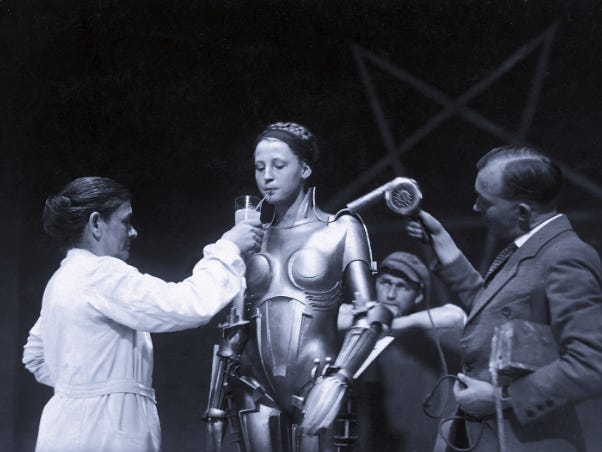
At the center of Metropolis are two heartbroken geniuses. The mad scientist Rotwang builds a humanoid robot, the “man-machine,” in the image of Hel, the woman who left him for another man and died in childbirth. Hel’s widower is Fredersen, the brilliant architect who runs the city with a firm technocratic hand. Fredersen employs Rotwang’s man-machine in a counterrevolutionary plot to keep Metropolis’ exploited working class from rising up against him. The two men’s actions, which dictate the fate of millions, are born out of grief and jealousy.
There is, of course, a couple. Freder, Fredersen’s son, falls in love with Maria, the voice and conscience of the working class. Deep in the catacombs of Metropolis, by the fire of a dozen candles, Maria preaches to the workers and gives them hope, she urges peace and patience. She christens Freder as the long-awaited “mediator” of the upper and lower classes, the one who has been promised to liberate them. Rotwang and Fredersen can’t allow that. Enter: man-machine.
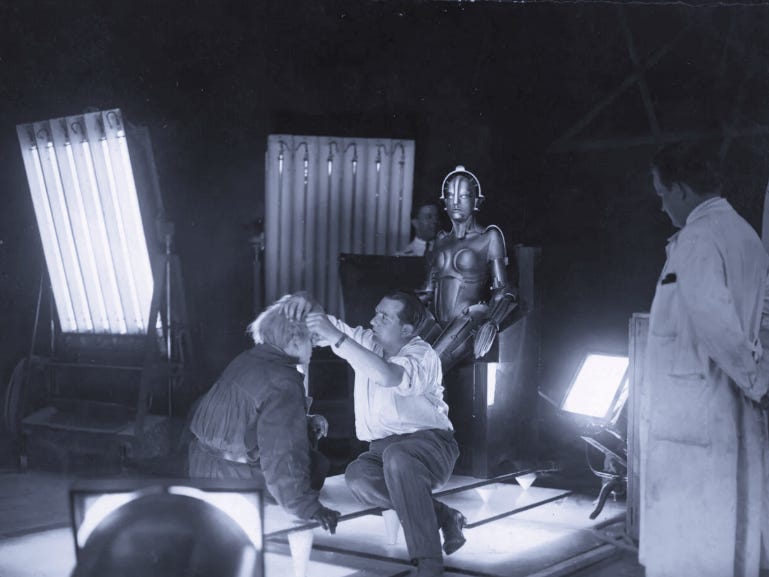
Though almost a hundred years-old, Fritz Lang’s portrait of AI, and our relationship to it, is eerily accurate. Rotwang kidnaps Maria to steal her likeness and transfer it onto the man-machine, then he commands it to “destroy the work of the woman in whose image you were created.” The machine, now possessing Maria’s knowledge and impulses, uses them to hypnotize the upper class with sex, and to captivate the working class with violence. All while Rotwang and Fredersen sit back and watch the anger that had previously been consuming them internally, destroy everyone else.
Today it’s not enough to view Metropolis as mere capitalist critique. Not in the midst of our transition from capitalism into the age of technofeudalism. Yanis Varoufakis, the economist who coined the term in his book Technofeudalism: What Killed Capitalism, describes our current economic system as one in which big tech companies function as feudal lords. Internet platforms are not a free market. These platforms are owned by a class of people who allow us to use their sites in exchange for collecting our data. Our endless scrolling is what makes them their fortunes. Like the serfs of medieval times who were trapped in a vicious cycle they could not name, we are “cloud-serfs” trapped in algorithms we don’t understand. AI is now an essential pillar of this nascent technofeudal system.
What Metropolis is actually doing, is showing us how technocrats wield their creations as weapons to distract and sow discord. And that any system which operates under the conditions of distraction and confusion, is by nature undemocratic. New technology often promises to unite and equalize, only to further entrench the already existing gulf of economic disparity. The public is not stupid for not understanding, this perpetual state of confusion is a deliberate fabrication of the technocratic class, which believes in its divine right to rule over the rest of us who are by nature less intelligent. The head comes before the hands.
The way out of this collective state of uncertainty is in the heart, by confronting the deeply personal, and therefore universal, question of purpose. Humans have been dreaming about AI for a long time, its arrival was inevitable. If God is dead outside of us, then it was time that we killed whatever was left of God within us. We created the thing that we aspire to be, this anti-consciousness which can “think” without the burden of free will. It can do what we can, and underneath it all are just blissful lines of code. And yet, who created the hand that created the code? There is no way to get out of the responsibility of our own humanity.
In the end, because the future is also the past, the masses of Metropolis burn the man-machine at the stake, believing it to be a witch. When the feminine façade burns away, the people stare at the metal husk in the shape of a person, with the strange feeling that something has eluded them.
Incredible work with exceptional words 📝🫶👏