

The Machine is the Container
Technopagans and the Carrier Bag Theory.

in the sky: venus conjoins jupiter (cancer), venus enters leo, new moon in gemini
in the cards: the fool, the chariot, four of cups
“We’ve all heard all about the sticks and spears and swords, the things to bash and poke and hit with, the long, hard things, but we have not heard about the thing to put things in, the container for the thing contained,” Le Guin writes in her essay, “The Carrier Bag Theory of Fiction.” The theory originates from Elizabeth Fisher’s Carrier Bag Theory of human evolution, which posits that the earliest cultural invention was not a spear, but probably a container to hold things that were gathered. Le Guin argues that stories (i.e. your art) should be like containers which hold all human experiences, not linear tales that lead toward a heroic struggle. If the hero’s journey feels too patriarchal to relate to, this should come as a relief.
As an artist, your tools are the things (mediums, materials, methods, frameworks, etc.) which help you to make the invisible, visible. What you use doesn’t matter so much as the intention you use it with. To embark on the hero’s journey at this particular moment in time, to choose the path of the artist, automatically puts you at odds with the most powerful tools we currently have. The technology which makes our work possible, is now threatening to make it obsolete. Not because it could ever replace the spiritual work that powers an authentic creative practice, but because it tempts us with an easy way out of the sacred mystery of the human experience, which is the only real responsibility we’re born to carry out.
To abdicate this responsibility is fatal to the spirit, and why so many artists are drawing anti-tech lines in the sand, in defense of their own human dignity, as well as the integrity of their work. What’s being safeguarded here is not the purity of some artistic product, but the right to a supernatural process. The hero’s journey is a rite of passage, and the urge to go through it is as primal as it is unexplainable. But how to do the work, when the sword our generation is called to wield is double edged? One way is to redefine our relationship with tech, to stop using it like a spear, and to use it as a carrier bag instead.
“So long as culture was explained as originating from and elaborating upon the use of long, hard objects for sticking, bashing, and killing, I never thought that I had, or wanted, any particular share in it,” Le Guin admits. The devices that make up so much of our reality appear exploitative because they are reflecting the unexamined human impulse that lives in each of us to exploit.
As righteous as it feels to antagonize it, the tech itself is inanimate, neutral. If we want to stick it to Freud, computers are actually quite yonic. Like opening an old purse or notebook, what comes out of them, whether we like it or not, is only what we ourselves have put in. What if we actually started paying attention to what we’re tossing in them?
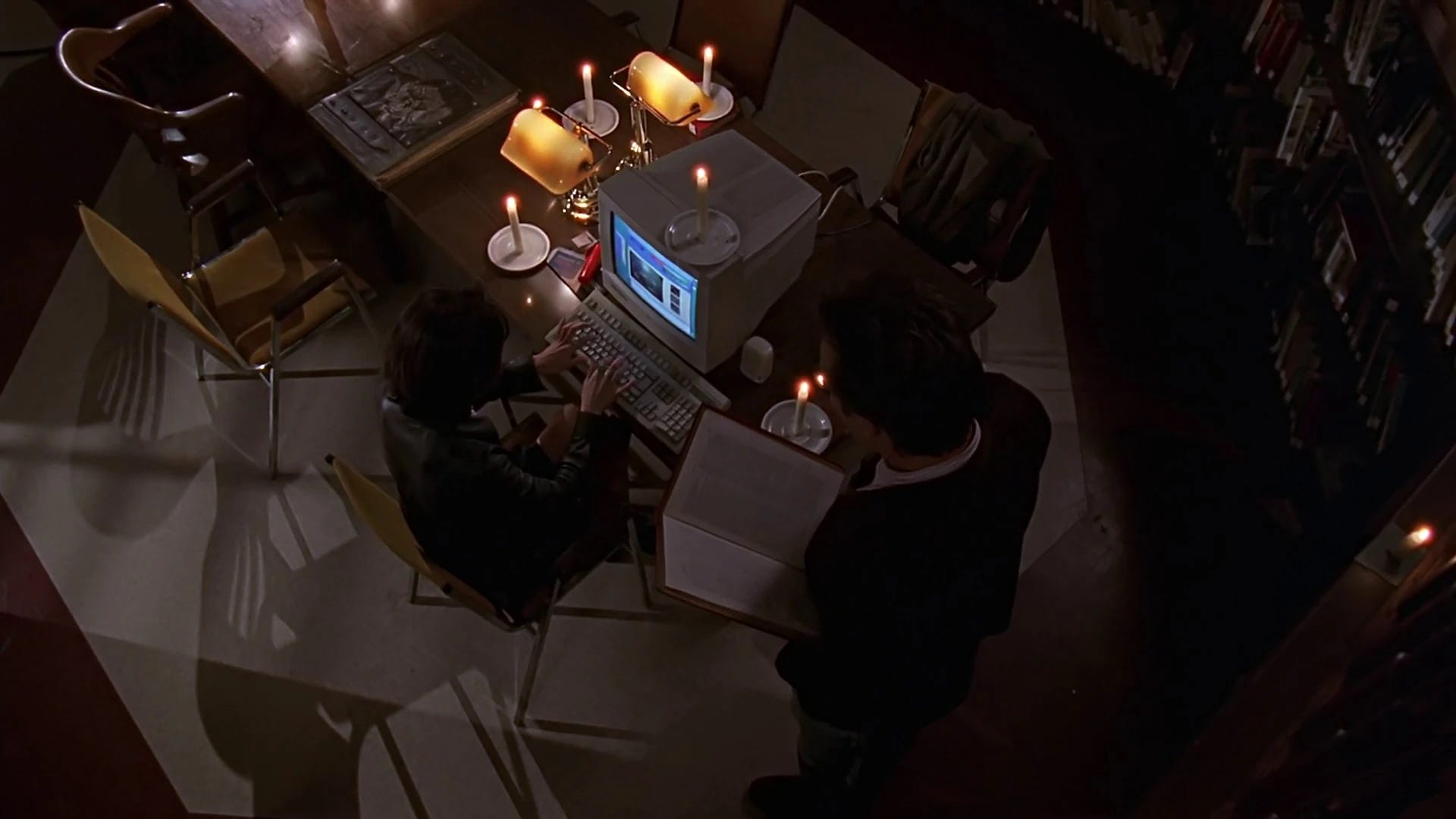
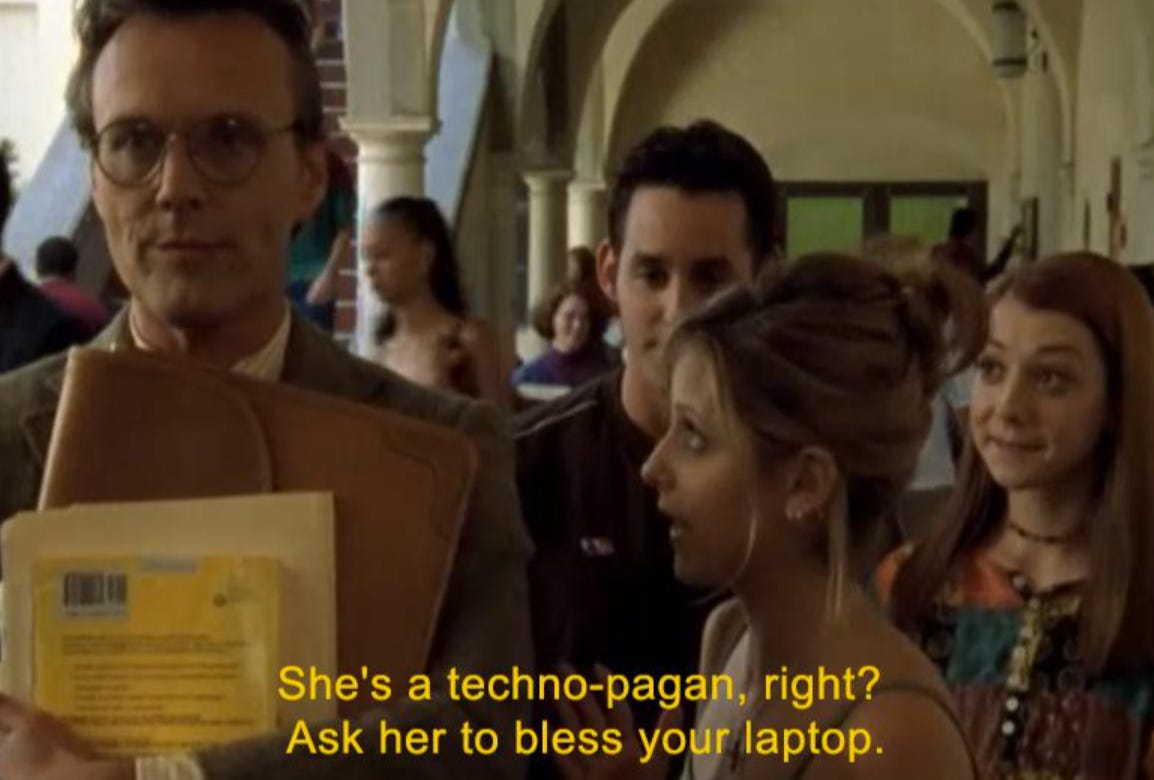
Jenny Calendar is the computer teacher at Sunnydale High. Her feminist technopagan rant in “I, Robot… You, Jane,” an early episode of Buffy the Vampire Slayer, blew my mind. She gets into an argument with Giles who is the school librarian, but more importantly Buffy’s “watcher.” Much like Alfred to Batman, Giles trains Buffy and is the keeper of the myths that help her to defeat evil. “You’re a snob. You think that knowledge should be kept in these carefully guarded repositories where only a handful of white guys can get at it,” Jenny tells Giles.
“Nonsense. I simply don’t adhere to a knee jerk assumption that because something is new, it’s better,” he retorts. “You think the realm of the mystical is limited to ancient texts and relics? That bad old science made the magic go away? The divine exists in cyberspace, same as out here,” Jenny says. Is our idea of the sacred and the divine so small, that we believe there are parts of our lives where it can’t reach?
Their fight, full of enemies to lovers’ tension, is deeper than books versus computers. It asks us where we believe magic truly lies, how it should be reproduced, and disseminated. A book can be as oppressive as your most hated social media site. A computer can be as liberating as the book that rocked your world when you were 13. The power lies completely with the perceiver. To disbelieve this, is to decimate the infinite potential of all mediums, and to insult your inherently divine nature as a human being, whose sole purpose is to use any and all forms to make the invisible visible.
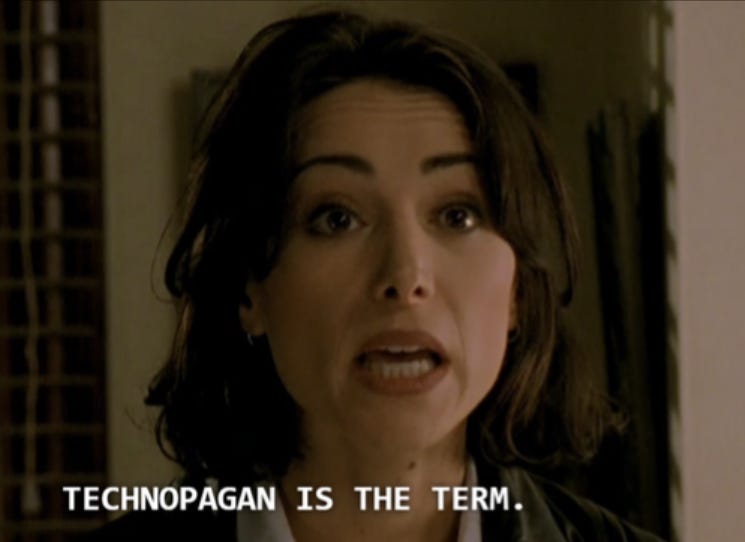
At the end of the episode, when Jenny and Giles have finished exorcising a demon out of the internet, she reminds him that it was his own archival efforts which caused the demon to escape in the first place, “Well it was your book that started all the trouble. Not a computer…”
Their argument takes us back to Gutenberg’s press. It gave us pamphlets, newspapers, and mass printed books. The written word went viral, and it destroyed the idea that God lived inside any one text. Ideas were tangible, and because they could be made, they could be unmade. Kings, lords, and priests everywhere were mad. Uranus had freshly entered Gemini then, just as it has now. Every tool we consider analog today, was once a brand new technology. Destructive at first due to our own ignorance, but later tempered with practice, care, and intention.
In 1998, a year after this episode of Buffy, The X Files dropped “Kill Switch” (S5 E11), its own technopagan episode. They were both likely inspired by Erik Davis’ Wired piece from 1995, “Technopagans.” In this feature, Davis dives deep into the brand new world of technopaganism, and how early internet users were seeding their intentions for the future of our relationship with computers.
Mark Pesce, one of the web developers interviewed says, “Computers are simply mirrors…There’s nothing in them that we didn’t put there. If computers are viewed as evil and dehumanizing, then we made them that way. I think computers can be as sacred as we are, because they can embody our communication with each other and with the entities- the divine parts of ourselves- that we invoke in that space.”
The entire feature is fascinating and has quickly become one of my favorite pieces of journalism. It perfectly captures the playful, idealistic, and bizarre nature of the early internet, where anything was possible. These online pioneers believed that the purpose of the new tech coming out of silicon valley was not to further alienate ourselves from the earth, but to bind ourselves to it inextricably. “Without the sacred there is no differentiation in space. If we are about to enter cyberspace, the first thing we have to do is plant the divine in it,” Pesce says.
The world they believed in is still possible, and is already underway.
Ursula K. Le Guin writes, “it is a human thing to do to put something you want, because it’s useful, edible, or beautiful, into a bag, or a basket…and then take it home with you, home being another, larger kind of pouch or bag, a container for people, and then later on you take it out and eat it… or put it in the medicine bundle or the shrine or the museum, the holy place, the area that contains what is sacred…”
A human life is not much more than a set of Russian dolls. Open yourself in half only to find an infinity of smaller selves without end, that is your divine nature. The tech you use to do your work can be sacred, if you’re willing to split it open and use it to that end.
Sources:
“The Carrier Bag Theory of Fiction” by Ursula K. Le Guin
“Technopagans” by Erik Davis
Buffy The Vampire Slayer S1E8: “I, Robot…You, Jane.”